How to Change Banks

With the unwelcome news that many of the nation’s biggest banks will soon be charging fees for debit cards usage — on top of lots of other fees — you may be thinking of switching banks. Ugh. What a chore. But you can save a nice chunk of change on an ongoing basis by sucking it up and moving to a better bank.
Here’s an eight step plan for making it happen…
Step zero: make up your mind
For starters, you need to decide whether or not you really want to make the change. If, for example, you place a high value on having access to a nationally-available ATM network, then switching to a local bank or credit union might not be such a great idea.
Another potential concern here is that the new bank that you’re targeting may be planning on adding fees, but hasn’t announced the changes yet. Thus, it might pay to wait a few months to see how things shake out.
Step one: find a new bank
Once you’ve decided to make the change, it’s time to find a new bank and open an account. Using the thought exercise you went through above, decide what you do and don’t like about your current banking relationship and then find a replacement that offers what you love while fixing the things that you hate.
Of course, you may not be able to find the 100% perfect solution here, so you may need to rank your criteria and settle for the lesser of several evils. Once you know the lay of the land, you might also want to re-visit step zero and be sure that you really want to make the switch.
Step two: change your direct deposits
Next, you’ll want to contact your employer and update your direct deposit information. It could take a couple of pay cycles to sort this out, so do this right away.
Step three: re-establish links to outside account
After you’ve talked to your employer about direct deposit, you’ll need to work your way through your other financial institutions and re-establish any linkages that will be broken when you finally close your old account. This could include links between your bank and an investment company, an online savings account, PayPal, etc.
Step four: move your billpay transactions
Now that you won’t have any money flowing into your old account, you better make sure you’re not still paying bills from there. Go through your billpay interface and move everything over to the new account. You should also be sure to check for auto-debits. For example, the company that picks up our trash auto-debits our checking account every three months.
Another big area, and one that’s easy to miss since they may only take out money once per year, is things like life insurance premiums. In some cases, you’ll need to make these changes through the payee instead of through your bank, so devote some time to getting these things sorted out.
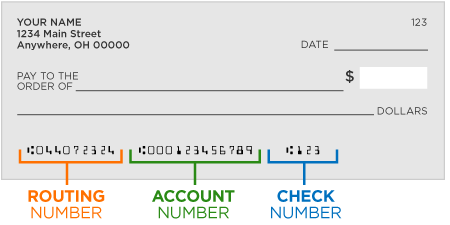
Step five: get new checks
In most cases, you’ll a free set of starter checks from our new bank. But if you don’t, or if you don’t get enough, you’ll need to buy some yourself. In general, it pays to shop around. While I’ve recently been able to get free checks from our bank, it wasn’t always this way. In fact, it’s often far cheaper to buy checks online than through your bank.
Step six: sit and wait
Ahhh. Everything is now done. Right? Well, hopefully. But maybe you missed something, so it’s best to sit and wait to be sure that all of your transactions are hitting your new account, and that you didn’t forget anything.
It’s also important to double-check that all of your checks have cleared. Right now, for example, I’m still waiting on a measly $7 check from last April to clear. I could follow up with the payee, but it went to a school group, and I’m honestly not sure who was in charge. So, for now, I wait.
You’ll obviously want to leave a cash cushion during this process in case anything pops up.
Step seven: close your old account
This is the most unnerving step because there’s always a chance, no matter how small, that you forgot something. After you’ve waited a few months and are satisfied that your old account is now totally dormant, go ahead and take the plunge. Draw your balance down to zero and close your account.
Ahhhh… There, doesn’t that feel better?
Disclaimer: Discover is a paid advertiser of this site.
Reasonable efforts are made to maintain accurate information. See the Discover online credit card application for full terms and conditions on offers and rewards.
Modified on October 7th, 2011 - 3 Comments
Filed under: Banking
About the author: Nickel is the founder and editor-in-chief of this site. He's a thirty-something family man who has been writing about personal finance since 2005, and guess what? He's on Twitter!
Related articles...
» Banks Reducing Overdraft Fees» Are You Switching Banks?
» Can Banks or Credit Unions Increase CD Early Withdrawal Penalties?
» Banks Back Off on Debit Card Fees
» Banks and Fraud: Bank of America Better Than Expected?
» FDIC Insurance Limits Increased to $250k
» New Debit Card Fees on the Horizon
» Addicted to Online Billpay?
Was this article useful? Please sign up to receive our content via e-mail:
3 Responses to “How to Change Banks”
Leave a Reply
Top Cards by Category
The new Discover it card is out to change the way people think about credit cards. No annual fee. No overlimit fee. No foreign transaction fee & no pay-by-phone fee. No late fee on your first late payment. And Discover won't increase your APR for paying late.*
Bonus Miles: Earn 30,000 bonus miles toward Award Travel after you spend $500 on the Card within the first three months of Cardmembership. Earn As You Spend: Get 2X miles on Delta purchases and 1X miles for all other eligible dollars spent.
The new Discover it card is out to change the way people think about credit cards. No annual fee. No overlimit fee. No foreign transaction fee & no pay-by-phone fee. No late fee on your first late payment. And Discover won't increase your APR for paying late.*
The SimplyCash(R) Business Card from American Express aims to help your business succeed with a generous cash-back rewards program. Many businesses can benefit from cash back categories such as U.S. office supply stores, wireless telephone services purchased directly from U.S. service providers and U.S. gas stations. This card not only offers a low introductory purchase APR but also doesn't charge an annual fee.
The new Discover it card is out to change the way people think about credit cards. No annual fee. No overlimit fee. No foreign transaction fee & no pay-by-phone fee. No late fee on your first late payment. And Discover won't increase your APR for paying late.*
- How to Become a Millionaire
- How to Get Out of Debt
- The Best Dollars I've Ever Spent
- How Our Estate Plan is Structured
- How We Paid Our Mortgage In Less than 10 Years
- Money Making Ideas
- How to Manage Your Asset Allocation with Multiple Accounts
- Consumption Smoothing - Save While the Saving's Good
- How to Save on Groceries
- How Much Life Insurance Do You Need?
- Eleven Great Books About Money
- Dave Ramsey is Bad at Math
- Dish Network Customer Service SUCKS
- $8,000 Homebuyer Tax Credit
- Pay Off Mortgage Early or Invest?
- How to Claim the First-Time Homebuyer Tax Credit
- Termite Control: Sentricon vs. Termidor
- How Much Should You Pay a Babysitter?
- Reduced Credit Limits? Share Your Experience
- Ethanol Blended Gas = Lower Mileage?
- $15,000 Homebuyer Tax Credit
- Buying Furniture off the Back of a Truck
- Will Mac OS X Lion Kill Quicken 2007?
How to save money on insurance
- Can you afford an international retirement living?
- How to help your family after you are gone
- Will Social Security be gone before I retire?
- Refund, or no refund?
- This battle of the sexes has no winner
- What to look for when buying an energy-efficient home
- The hidden savings in a rent payment
- How to save money on vacations using social media and new technologies
- How to budget without regular paychecks
- What do you do with your windfalls?

October 3rd, 2011 at 3:31 pm
Changing banks can be a disaster if done wrong so info like this is very helpful. Thanks.
October 4th, 2011 at 5:42 pm
Step One — add’l
Make sure that the bank’s privacy practices and any opt-outs are appropriate to your needs e.g., you make ask that they do not allow you to be solicited for pre-approved credit card offers
Step Five — add’l
Decide on a debit or ATM card, making sure you know their daily limits
Step Six — add’l
Make sure that cash cushion exceeds daily balance requirement or else you may get charged a monthly fee
October 8th, 2011 at 9:00 pm
I just did this. My husband has been a Wells Fargo account holder since junior high school, and I have been since we married. These new fees (for checking accounts and debit cards) finally drove us away. We definitely wanted the benefits of a larger bank but without all these ridiculous fees that have been cropping up. We debated ING Direct, since we had our savings there, but with the new sale, we were leery of the change. We finally decided to go with Ally and just finished the last balance transfer this past week. We’re closing our ING account, too. (We have a local savings at a credit union, which is our “need it right-now emergency fund”.
The biggest issue for closing our WF account was losing ALL access to our past statements. I’m not even sure if they are going to send us our last statement, although if they don’t, we will be calling them for tax purposes.